USAF/DOD Fire Academy History
History
of Lowry Air Force Base, Colorado
1934-1938:
The Denver Chamber of Commerce petitions Congress to locate the Air Corps Tech School
in Denver. Sanitarium is converted and donated to the federal government.
1938:
First troops arrive in Denver. Denver branch of the Air Corps Tech School
becomes Lowry field.
In 1993 it was announced that
Lowry AFB, at the east edge of the City of Denver, Colorado, would be closed as
part of cost reduction measures being taken by the US military. Lowry AFBclosed
on 01 October 1994. On 12 April 1993 the Air Staff approved moving small
missile maintenance training from Lowry AFB to Vandenberg AFB, California,
where it would be consolidated with large missile maintenance training.
The Air Reserve Personnel Center
is an active-duty FOA located on the grounds of the former Lowry Air Force Base
in Denver. Its workforce is charged with providing essential services and
administration for the nearly half million women and men of the Air Reserve
components in support of the Air Force mission. The center also maintains the
master personnel records of all Air National Guard and Air Force Reserve
members. The Defense Finance Accounting Service - Denver Center (DFAS-DE) is
located on Lowry Air Force Base (AFB).
Lowry Air Force Base has been an
integral part of the history of the US Air Force and the city of Denver for
over 60 years. The base was named after Denver native, US Army Lt. Francis B.
Lowry, who was killed in action during World War I. Lowry was an observer in an
aircraft that was shot down over enemy lines near Crepion, France on September,
1918. Lowry Field was originally located near East 38th Avenue and Dahlia
Street. This airfield hosted both US Army Air Corp and Colorado (Air) National
Guard units. This site is now occupied by Park Hill Municipal Golf Course.
In 1937, President Roosevelt
authorized funds to relocate Lowry field to its final site near East 6th Avenue
and Quebec Street. The base started its training mission in earnest the
following year. World War II caused Lowry to greatly expand it facilities in
order to train bomber aircrews along with a large number of other technical
specialists.
After the war, Lowry continued
to train technicians for all branches of the US military. On June 7, 1951,
Lowry’s 3415th Technical Training Wing formed a Guided Missiles Department. It
taught courses in guidance, control, and propulsion for such systems as
Matador, Falcon, Rascal, Snark, and Navaho. By 1962, the Department of Missile
Training was providing the Air Force with over 1,000 trained missile
specialists per year.
From 1953 to 1955, Lowry became
President Dwight D. Eisenhower's "Summer White House" from which he
conducted affairs of state while Mamie Eisenhower, a Denver native, visited
with family. 1953 also turned Lowry into a movie star with the filming of The
Glenn Miller Story starring Jimmy Stewart, June Allyson, and Harry Morgan. Several
scenes were shot in and around the hangar that now houses the Museum. In 1955,
the United States Air Force Academy was established at Lowry AFB pending
construction of its facilities in Colorado Springs. On 11 July 1955 the first
class (of 306 cadets) was sworn in at the Air Force Academy's temporary
location at Lowry AFB. The USAFA remained in operation at Lowry from 1955 to
1958.
Due to the close proximity of
the residential area around Lowry and the increase in the number of high
performance jet aircraft accidents at the base, flight operations at Lowry
ceased in 1966. In 1976 the US Air Force Accounting and Finance Center moved
from its old location near East 40th Avenue and York Street to newly built
facilites at the southwest corner of the base.
April 1991:
Lowry closure announced.
February 1992:
Lowry economic recovery project is established by cities of Denver and Aurora.
November 1993:
Community Reuse Plan submitted to the Air Force.
August 1994:
Lowry Redevelopment Authority (LRA) formed.
September 1994: Lowry Air Force
Base Closes
History
of Greenville Air Force Base, Mississippi
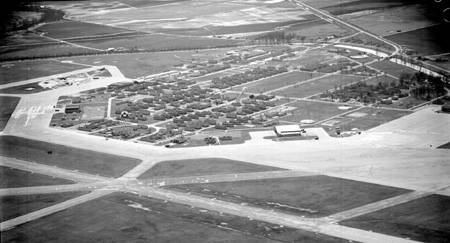 Built
in 1942, Mid-Delta regional Airport (MDRA) started life as an Army Air Corps
training field. After World War II, the base was closed. Activated again during
the Korean War, the base reopened as Greenville Air Force
Base. Although under a different name, the mission was the
same, pilot training. Greenville Air Force Base
remained opened until 1965 when the base was closed and given to the City of
Greenville.
Built
in 1942, Mid-Delta regional Airport (MDRA) started life as an Army Air Corps
training field. After World War II, the base was closed. Activated again during
the Korean War, the base reopened as Greenville Air Force
Base. Although under a different name, the mission was the
same, pilot training. Greenville Air Force Base
remained opened until 1965 when the base was closed and given to the City of
Greenville.
History of Chanute Air Force
Base, Illinois
Chanute Air Force Base is located on the
southern edge of Rantoul (Champaign County), Illinois. The main Base is
comprised of 2125 acres. The primary  mission of the AFB was to provide military and
technical training for Air Force officers, airmen, and civilian employees, and
for other Department of Defense agency personnel. Training activities focused
on operation and maintenance of military aircraft and ground support equipment.
mission of the AFB was to provide military and
technical training for Air Force officers, airmen, and civilian employees, and
for other Department of Defense agency personnel. Training activities focused
on operation and maintenance of military aircraft and ground support equipment.
Chanute Field (640 acres) was constructed,
initially serving as a pilot training facility and a storage depot for aircraft
engines and paint in 1917. From 1922 through 1938, Chanute served as a training
school for all Air Corps mechanics. The Air Corps Technical Training Command
was initially headquartered at Chanute in 1941. Technical training operations
during World War II included aircraft maintenance, weather observation, life
support, and metal processing.
Following World War II, Chanute continued
to serve as a training installation for aerospace and weapon system support
personnel under a variety of organizational titles. The installation was
designated in 1959, the Chanute Technical Training Center, which was later
designated the 3330th Technical Training Wing. In July 1971,
military flight operations were terminated at Chanute, and it became a
non-flying training Base. All military operations ceased in September 1993, and
the facility became available for other uses, including civilian and
commercial. The Air Force Base Conversion Agency (AFBCA) currently oversees all
Base closure and conversion activities, in conjunction with the Illinois EPA
and U.S. EPA.
History of Goodfellow Air Force Base, Texas
San Angelo Field was designated
as a site for United States Army Air Corps pilot training on June 21, 1940. The
base, located in Tom Green County two miles southwest of San Angelo, opened in
August 1940 as the home of the San Angelo Air Corps Basic Flying Training
School. On May 27, 1941, the facility was renamed Goodfellow Field in honor of
a former San Angelo resident and native of Fort Worth, John J. Goodfellow, Jr.,
who was killed while serving with the Twenty-fourth Aero Squadron in France
during World War I. The first class of
aviation cadets arrived for basic flight training in BT-13 aircraft in January
1941. Members of the Women's Air Force Service Pilots began duty in June 1943.
In September 1945 the mission was changed to primary flight training. The base
was deactivated in May 1947.
Goodfellow Field was reopened in
December 1947 as Goodfellow Air Force Base, a basic pilot-training school of
the newly independent United States Air Force. In June 1954 the base mission
was changed to multi-engine flight training in B-25 twin-engine Mitchell light
bombers. Secretary of the Air Force Donald A. Quarles announced in February
1956 that Goodfellow had been designated a permanent military installation. The
flight-training mission at San Angelo came to an end on September 3, 1958, with
the graduation of the last pilot class. Almost 20,000 officers and cadets had
been trained at the Texas base. On October 1, 1958, under control of the United
States Air Force Security Service, Goodfellow became the location of a school
to provide cryptologic training to students from all four United States
military services. Although the mission remained the same, Goodfellow Air Force
Base was returned to the Air Training Command on July 1, 1978. Following
several threats during the 1970s to deactivate the San Angelo installation, the
base was removed from the closure list in 1981 and assigned an additional
mission as part of the phased-array radar-warning system, a nationwide network of
radar protection against sea-launched ballistic missiles. The actual site of
the weapons system, one of only four such systems in the continental United
States, was to be a 130-acre tract in the northeast part of Schleicher County,
south of San Angelo.
In 1985 the base was designated
a technical training center. During the next three years the training center
brought to Goodfellow advanced imagery training from Offutt Air Force Base,
Nebraska, electronic intelligence-operations training from Keesler Air Force
Base, Mississippi, and targeting-intelligence applications and
general-intelligence training from Lowry Air Force Base, Colorado. In July 1993
the Seventeenth Training Wing was activated at Goodfellow. The Seventeenth has
a long history of combat operations going back to World War I. In World War II, the Seventeenth conducted
the "Doolittle Raid" on Tokyo, Japan. Under the designation
Seventeenth Bombardment Wing it participated in the Korean War. During the
Vietnam period the wing conducted B-52 refueling. After being redesignated the
Seventeenth Reconnaissance Wing in October 1982, it operated TR-1 high-altitude
reconnaissance aircraft during Desert Shield and Desert Storm on the Persian
Gulf. The wing was deactivated in 1991, then was reactivated as the training
wing at Goodfellow, after which it provided cryptologic and
general-intelligence training for air force, army, navy, and marine personnel
as well as students from Allied countries. In the early 1990s the growing base
was undergoing extensive modernization. Under construction were new training
facilities, dormitories, dining halls, a youth center and new physical fitness
center. As the base entered its second half-century it was one of the most
modern installations of the United States Air Force.